-3.png)
Women’s Asian Cup 2026: The Girlactico Explainer

Mid-season tournament? Body clocks on Australian time? Your WSL faves linking up internationally?
Welcome to the Women’s Asian Cup, the oldest women’s international tournament in the world and, this year, one with serious stakes. Running from March 1st-21st across Perth, the Gold Coast and Sydney, the competition is celebrating its 50th anniversary, and it’s doing it with history, drama and World Cup qualification all on the line.
Here’s everything you need to know.
The History (And Why It Matters)

The Women’s Asian Cup is the oldest women’s national team competition in the world, first played in 1975. Fun fact, between 1975 and 1981, matches were only 60 minutes long… but the game has evolved massively since then.
China are the most successful nation in the tournament’s history, lifting the trophy nine times. They’re also the current champions, and when it comes to tournament pedigree, nobody in Asia matches their consistency.
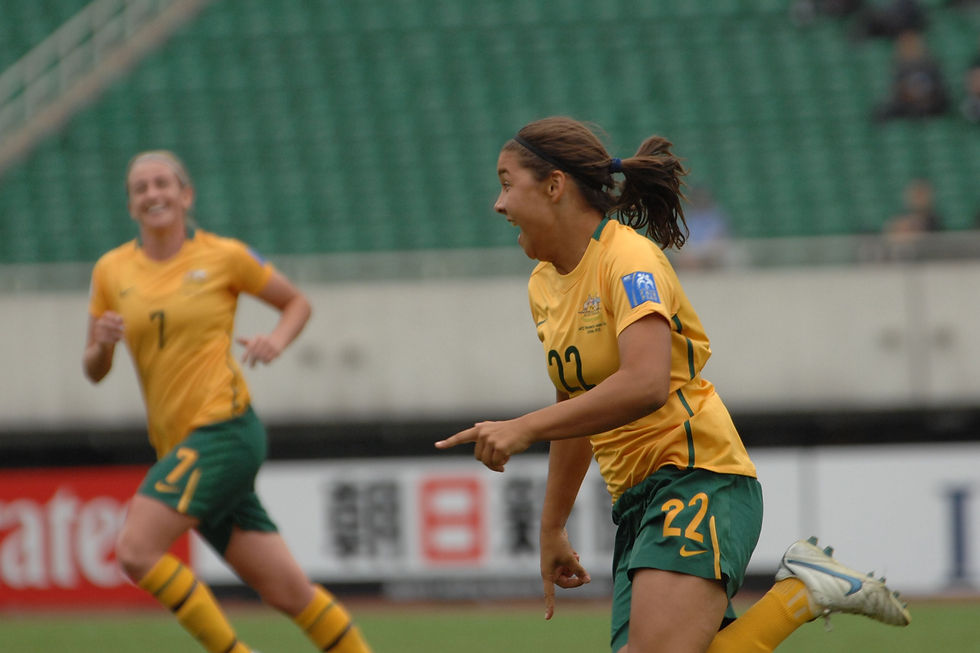
Hosts, meanwhile, haven’t always had fairy-tale endings. The home nation has only lifted the trophy once, in 2010, a tournament where a 16-year-old Sam Kerr made her first mark on the international stage, scoring her first goal and even stamping the trademark on her backflip celebration. In 2022, Australia’s campaign felt underwhelming by their standards, despite the squad being stacked.
The Format
The structure is clean:
12 teams: 3 groups of 4
Kicks off with group stage format
Top two from each group qualify automatically for knockouts
The two best third-placed teams also go through


Graphic Credit: The AFC

Participating Teams:
Group A: Australia, Iran, South Korea, Phillipines
Group B: Bangladesh, China, Korea DPR, Uzbekistan
Group C: Chinese Taipei, India, Japan, Vietnam
That gives us eight teams in the quarter-finals. From there? Straight knockout football all the way to the final. The final will be held at Stadium Australia in Sydney, while the opening match, featuring hosts Australia, kicks off in Perth.
Expect late alarms, coffee-fuelled matchdays and fully committed time-zone maths.
Why This Tournament Is Bigger Than It Looks
This isn’t just silverware on the line.
The Women’s Asian Cup is also acting as qualification for the 2027 Women’s World Cup in Brazil, and it’s the last time World Cup qualification will run through this format.
Here’s how it works:
The four semi-finalists automatically qualify for Brazil 2027.
The losing quarter-finalists enter play-in matches.
Two of those will qualify directly.
The other two head to the FIFA Play-Off Tournament.
So, there’s the opportunity for up to eight Asian nations to ultimately qualify. So yes, it’s mid-season. But it’s also World Cup destiny territory.
Favourites to Win
Japan

Japan have lifted the trophy twice and are, once again, serious contenders. They might not dominate physically in the same way some nations do, but technically? Elite. Their squad is stacked with players currently playing in the WSL, one of the most physical leagues in the world, so this exposure is strengthening them for international football.
And let’s not forget, at the 2023 World Cup, Japan stunned Spain with a 4-0 group-stage win. Spain went on to win the whole tournament, but J
apan made a statement in that game.
Australia

The Matildas are playing on home soil, and the hype is real. Last time they hosted a major tournament (2023 Women’s World Cup), they reached the semi-final, so fans will be there in full voice.
After a slightly disappointing campaign in 2022, expectations are high. The team is stacked with WSL talent: Sam Kerr, Caitlin Foord, Kyra Cooney-Cross, Steph Catley, Alanna Kennedy, Clare Wheeler, Katrina Gorry… the list goes on.
The big question: can new coach Joe Montemurro deliver on home turf? With so much talent and home support behind them, anything less than a deep run would feel like a missed opportunity.
WSL Players to Watch Out For
Let’s be honest, half the fun of a tournament like this is watching your club favourites switch shirts.
Sam Kerr is looking for a comeback tournament, and which better to kick it off with one at home. Sam is one of the best strikers in the world, lethal in front of goal, and coming off an ACL injury. If she shines here, it’s a serious statement.

Kiko Seike brings power and pace for Brighton, and is a real one to compete for best striker against Sam Kerr.
Caitlin Foord’s dribbling ability, dragging defenders wide to create chaos at the edge of the box, is trademark.
Honoka Hayashi offers forward-thinking midfield play and relentless work rate.

Kyra Cooney-Cross has had limited minutes at Arsenal recently but always shows up internationally, and loves scoring a banger.
Yui Hasegawa is the metronome for Manchester City, and one of the most versatile midfielders in the league.
The Backlash: Where’s the Prize Money?
Here’s where the shine dulls slightly. Despite being billed as the most successful Women’s Asian Cup to date, and celebrating its 50th anniversary, prize money will not increase from the 2022 edition.
In 2022, the AFC introduced prize money for the first time, distributing US$1.8 million among the top four teams. Compare that to 2023’s men’s Asian Cup, where the AFC allocated US$14.8 million, with all 24 teams receiving a US$200,000 participation fee.
Right now, the Women’s Asian Cup is the lowest-paying continental tournament in the world.
The AFC has stated that commercial growth is still developing and that increases in prize money must be backed by revenue sustainability. But critics, including Shoko Tsuji, secretary general of FIFPRO Asia/Oceania, have questioned that justification, especially at a time when visibility and audience engagement in women’s football is at an all-time high.
The Girlactico Take
Yes, it’s mid-season. Yes, we’re adjusting sleep schedules. Yes, WSL managers are probably nervously watching. But this is what growth looks like, global tournaments woven into club seasons.
The Women’s Asian Cup isn’t just another competition, it’s a point to prove, and has significant silverware to be won.


Comments