-3.png)
Why Women’s Football Needs More Rivalry

Men’s football has always understood the power of rivalry. It is loud, tribal and unapologetically hostile in ways that feel ritualistic rather than reckless. Entire stands move as one body, with generations inheriting not only clubs, but enemies. The North London Derby does not need explaining in the men’s game. The call of ‘What do we think of Tottenham?’ is instinctive and automatic, almost a cultural muscle memory. Rivalry is embedded in the architecture of the sport, giving matches weight before a ball is even kicked.
Women’s football, meanwhile, has grown exponentially in professionalism, visibility and technical quality. Stadium attendances are rising, broadcast and media coverage is expanding and the talent on show is undeniable. Yet for all its growth, something still feels restrained. Not in ability, and certainly not in ambition, but in edge. The tension rarely simmers in the same way. The question is whether it has been allowed to fully embrace rivalry in the way men’s football has always done.
Rivalry Is Built, Not Manufactured
Part of this is structural. Rivalries in the men’s game were forged over decades of geography, class divides, industrial competition and political tension. They were shaped by repetition and memory, by contested titles and controversial moments that lingered for years. Women’s football, in its modern professional form, has not had the same uninterrupted historical journey. Many clubs have restructured, rebranded or only recently invested seriously in their women’s sides - history is still being written.

The North London Derby in the women’s game illustrates this imbalance. Arsenal have long been the established force of serial winners, a benchmark for success. Tottenham, until recently, have struggled to consistently compete at that level. When one side dominates and the other fights for stability, the stakes inevitably feel diluted. Rivalry thrives on risk. It needs proximity in the table, the sense that something tangible is at risk. If the outcome feels predictable, the emotional investment feels less than.
This season, however, feels different. Spurs are enjoying one of their strongest campaigns, and the gap appears narrower than in previous years. Suddenly, the North London Derby on 29th March carries more weight. There is more pride on the line, more tension bubbling beneath the surface. It is in these moments, when competition tightens, that genuine rivalry can begin to take shape.
The Politics of Being ‘Nice’
To answer that, we have to look beyond football and towards culture. Women have long been conditioned to be modest, gracious and measured. To celebrate, but not too loudly. To compete, but not appear aggressive.
Aggression in men is framed as passion; in women, it is often framed as a personality flaw. Men’s derbies are described as ‘heated’ and ‘fiery,’ while women’s fixtures are softened with language like ‘spirited’ or ‘spicy.’

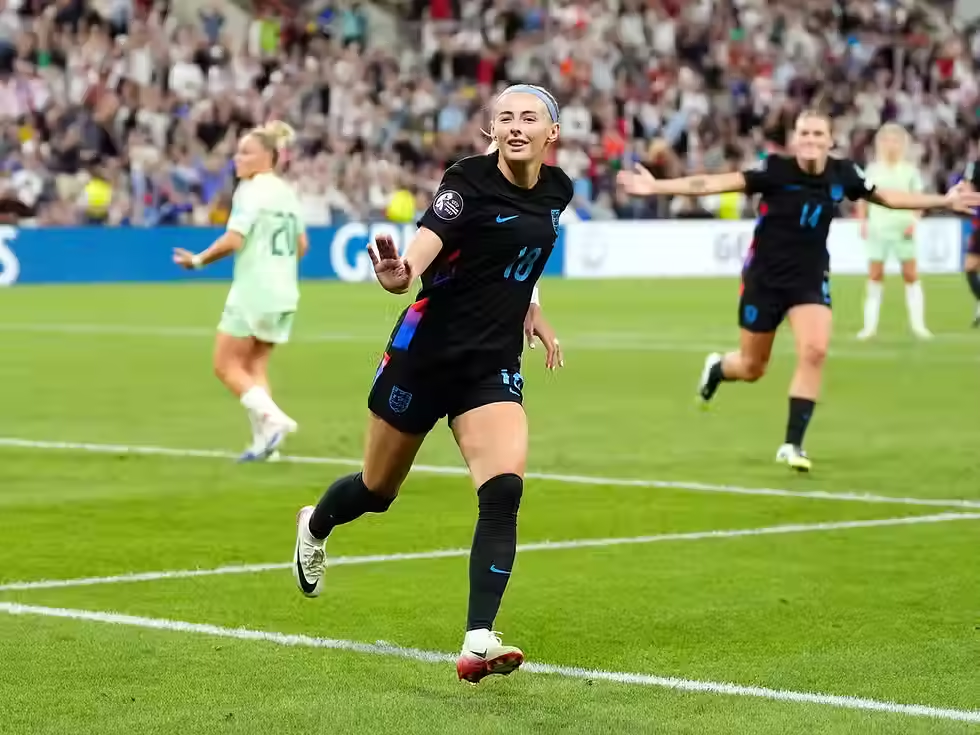
Women’s footballers are still often positioned as ambassadors first and competitors second. They are set the task of growing the game, inspiring the next generation and maintaining a certain image. All of that matters, but it can also create an invisible boundary. Rivalry requires a willingness to admit that some games matter more than others, that certain opponents provoke something deeper. It requires players and fans to lean into tension rather than sailing over it. And some players are already showing the way: Chloe Kelly, letting her 'calm' celebration from her rebound penalty at the Euros 2025 speak for itself, or Alex Morgan, scoring against England in the 2019 World Cup, and following it up with the sipping tea celebration. Both harmless in retrospect, but equally adding that fire to intense games.
The women’s game has also been deliberately branded as family-friendly, and rightly so in many respects. It has offered an alternative to some of the hostility and exclusion that is present within the men’s game. Lower ticket prices, accessible players, a welcoming atmosphere, all of which have been strengths. But when family-friendly becomes synonymous with sanitised and restrained, something is lost. A stadium full of families does not have to mean a stadium without fury. Children can learn chants just as easily as adults - albeit without the swearing…Inclusivity does not require the removal of edge.
Theatre and Folklore
This does not mean replicating the worst elements of the men’s game. Women’s football does not need the violence, the abuse or the toxicity that can overshadow men’s rivalries. What it can take, however, is the understanding that sport is theatre. Theatre needs narrative, and narrative needs conflict. A derby without edge is just another fixture.

Moments like the now-infamous sock-gate at Stamford Bridge show how quickly theatre can emerge. Arsenal being forced to wear Chelsea socks due to a kit clash error was chaotic and immediately memorable, for not just the home and away fans, but everyone across women’s football. In another context it might have been brushed off as a logistical mishap, but within a London derby it carried weight. Chelsea fans, and the rest of the WOSO community found humour in it; Arsenal fans, maybe not so much… These moments should not be flattened, but instead should be allowed to linger and contribute to the story. Women’s football can create its own storylines within rivalry, away from the men’s.
Permission to Be Loud
Rivalry will not arrive through polite marketing campaigns or carefully worded press releases. It grows in atmosphere, in repetition, in moments that feel unscripted and emotionally charged. And increasingly, clubs seem to understand that energy in the stands is part of the equation.
At Chelsea, chants are displayed on the big screens, encouraging supporters to sing along and build a unified voice in the stands. It may seem small, but it is an acknowledgement that atmosphere does not happen by accident. At Arsenal, sections of the Emirates have been branded ‘Bring the Noise,’ creating a concentrated section of supporters tasked with driving volume and energy throughout the stadium.

Women’s football has built its growth on inclusivity and community, and that foundation must remain. But inclusivity does not require emotional restraint, and passion does not have to be sanitised to be safe. If football culture includes rivalry, then women deserve access to that dimension and atmosphere too, because competition with passion is a part of the game.
But this isn’t just about attendance, it’s also about how we show up. There’s still a sense that we should be gracious and well-behaved, even at a football game. Maybe it’s time to let that go. If women’s football is our space, then we get to decide how it feels.


Comments