-3.png)
The Iranian Women’s Team: when football becomes the face of war


Women’s football has never really existed as “just football”, not in Iran and not, if we’re being honest, anywhere else. But in Iran in particular, the game has always come with conditions attached, shaped by decades of restriction, resistance and, at times, international pressure forcing change that never fully settles.
For years, women weren’t even allowed inside football stadiums. Following the 1979 revolution, they were effectively banned from attending matches altogether, shut out of one of the country’s most visible public spaces for more than four decades. Sahar Khodayari became the most widely known symbol of that exclusion in 2019, after setting herself on fire outside a courthouse when she faced a possible prison sentence for trying to enter a stadium disguised as a man. Her death sparked international outrage and, under pressure from FIFA, Iranian authorities began allowing limited numbers of women into matches later that year, particularly around men’s World Cup qualifiers. But even that shift never represented full access or full acceptance. Women were allowed in controlled numbers, often segregated, sometimes barred again entirely, a reminder that their presence in football remained conditional rather than equal. What emerged from that period was not a straightforward story of progress, but a pattern: visibility granted under pressure, then restricted again once that pressure eased.
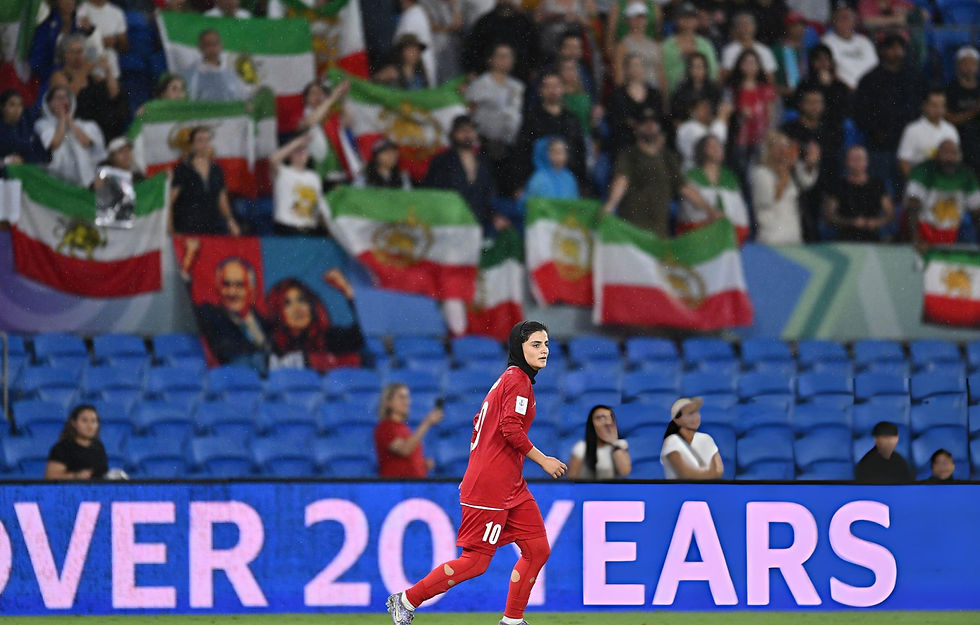
It is within that history that the current moment sits. When the Iranian women’s national team refused to sing the anthem for their opening game of the Asia Cup in Australia, it was immediately framed as a clear act of defiance, and in many ways it was. These are players who acted knowing the risks, knowing that representing a country on an international stage also meant being expected to perform loyalty in a very specific way. But what followed made it clear that this was never just symbolic. Players were labelled “traitors”, more specifically “wartime traitors”, and reports quickly emerged that pressure was being applied not only to them, but to their families back in Iran, turning what might appear to be an individual act into something collective and far more dangerous.

As the situation escalated, that pressure became visible in ways that were difficult to ignore. After their elimination, members of the team signalled distress while leaving their hotel, making the universal SOS gesture towards cameras, a moment that cut through the usual language of sport and suggested something far more urgent was unfolding behind the scenes. Shortly afterwards, several players ran from the team environment and sought asylum in Australia, fearing what would happen if they returned. Others initially followed and then reversed their decision, choosing to go back to Iran despite those fears, with reports indicating that threats against family members played a role. Some players sought asylum. Others returned home despite those risks. From a distance, that can look like a split between different choices. In reality, it reflects the same pattern that has shaped women’s football in Iran for years: participation that is allowed, but never free from consequence, visibility that is granted, but always monitored. And yet, as this story has travelled, it has taken on another role as well.
Because outside Iran, the players’ actions have quickly been folded into a broader narrative about the country itself, presented as clear evidence of oppression, which, again, is not untrue. But it is difficult to separate that framing from the wider political context in which it is now being used. When figures like Donald Trump take to platforms like X to call for Australia to grant these players asylum, it is framed as concern, a public gesture that positions him as someone advocating for their safety. But that gesture sits alongside a far more uncomfortable reality. At the same time, the United States, alongside its allies, continues military action against Iran, including a strike just days earlier on a girls’ school in Minab that reportedly killed at least 165 schoolgirls. In that context, the contrast is difficult to ignore. The same leadership presenting itself as a protector of these women is also connected to the violence shaping the country they would be fleeing. It becomes about image as much as anything else. These players, and their very real fear, risk being used as part of that image, their stories helping to construct a version of moral authority while the consequences of war continue to unfold elsewhere. In that sense, they are not just caught in a political situation, but pulled into it, their lives becoming part of a much larger narrative that they do not control.
Which is where the story becomes even more difficult to sit with. Because these players are both things at once: individuals navigating genuine danger, and figures whose actions are being used to support narratives far beyond their control. Women’s football in Iran has always been shaped by forces outside the game itself. What we are seeing now is what happens when those forces collide in real time, and the consequences land not on institutions or governments, but on the players themselves.
And in the middle of all of that, it is worth returning to the simplest part of the story, the one that is easiest to lose. These are women who wanted to play football, who now find themselves navigating threats, separation from their families and decisions that carry consequences most people will never have to consider. Whatever this story becomes in political terms, it still belongs, first, to them. And it is them, more than anyone else, who should be thought of now, not as symbols or arguments, but as people, whose safety and country’s peace remains uncertain.


Comments