-3.png)
The full history of Women’s Football

You might think the world of women’s football, as it looks now, is a modern invention. From the sold out stadiums, brand and broadcast deals and record breaking crowds, making the game feel relatively new. Yet the truth is, women have been playing football, as long as football has been around.
Long before the structured way of the game was formed - leagues, competitions - women were already kicking a ball around, even dating as far back as the 16th century, including in a poem written in 1580 describing women playing football with their skirts tucked up so they could run.

By the late 1800s, the game wasn’t just for casual fun anymore, women were forming teams. In 1895, the British Ladies’ Football Club staged a match in London between teams representing the North and South of England, with more than 10,000 fans turning up to watch.
What is important to remember, is that women’s football has been popular since the beginning, and yet that popularity didn’t mean acceptance.
The First Boom
The game really exploded during the First World War, as did the role of women in society as well. Roles that were traditionally labelled as jobs for ‘men’, were now taken over, and proved to be capable of being completed by women. As in men’s work culture, women in many workplaces formed football teams, both for exercise and morale.
One of the most famous was Dick Kerr Ladies, a factory team from Preston, in the North of England. This team became one of the most successful sides in the country, playing hundreds of matches and drawing huge crowds. Their star player, Lily Parr, would go on to score an estimated 900 goals in her career, showing up the likes of Sam Kerr and Bunny Shaw achievements. The women’s game now is surrounded by such a broad creative culture, and there have been many play adaptations of the Dick Kerr Ladies, including Munitionettes, which is currently crowdfunding.

By 1921, around 150 women’s teams had been formed in England, with regularly occurring matches attracting tens of thousand fans. On Boxing Day in 1920, a game between Dick, Kerr Ladies and St Helens Ladies drew a crowd of 53,000 at Goodison Park… Compare that to Everton Women, who still play at Goodison Park today, where their highest attendance at Goodison this season is just under 7000.
The stats tell us that the women’s game wasn’t struggling, but instead, it was thriving. And that, arguably, was the problem.
Football, Control and Women’s Bodies
The ban in 1921 didn’t appear out of nowhere, it instead reflected something much bigger than football. In a post-war Britain, as men returned home, women were expected to leave the industrial and engineering jobs they took during the war to return to domestic or, at best, lower-paid roles. Women were viewed as ‘temporary’ workers, and were pressured back into domestic life, or lower skilled work, creating a glass ceiling that dismissed their capability.
Alongside this, for centuries, women’s bodies had been governed by rules about what they could and couldn’t do. In the context of women’s footbal, it was framed as dangerous for women, with doctors claiming physical activity could damage their health or make them less ‘feminine’ whatever that means…
Football, with its running, tackling and natural sense of aggression, along with its prior public popularity, challenged those ideas directly. Women playing the game weren’t just playing a game of football, but instead, they were taking up space in public life.
When the FA declared the sport ‘unsuitable for females’, it sounded like it was on the basis of medical judgement. In reality, it was part of a long tradition of institutions deciding what women should be allowed to do.
That pattern is hardly unique to football, or women across the world - even today - but the ban shows how quickly a growing movement can be shut down when it threatens the status quo.
The Ban
In December 1921, the English FA announced that women would no longer be allowed to play on grounds affiliated with the FA. Their reasoning was blunt and to the point: football was ‘quite unsuitable for females’.
This 50 year ban was the pause on women’s football that we still reap the repercussions of today. The problem you have when you ban people from something they once had access to - or should have access to - is that it rarely makes that activity disappear, it just pushes it into less safe spaces.

The 1921 ban did not stop women playing the game, but alternatively forced them out of proper stadiums and into public parks and informal spaces. They lose access to facilities, coaching, referees and support structures that the men’s game got without question. The game didn't disappear, it instead became harder, less visible and less supported - much of which we still see the effects of today, in literal access, and also, more importantly, mentality.
This is a pattern that echoes far beyond football, and is all too familiar. Throughout history, women’s lives have often been governed by rules about what they should and shouldn't do with their bodies, time or ambitions. Restricting access never eliminates desire, it forces people to find other ways.
Women didn't stop playing football, they just had to fight so much harder to keep on doing it.
Keeping the Game Alive
As time passed, small groups of organisers and players worked quietly to keep women’s football going. Clubs like Manchester Corinthians travelled across Europe and sometimes even further, playing matches and raising money for charity. Others were based locally, creating their own tournaments and informal leagues. And yet, they still had no backing from football’s governing bodies, with the game relying heavily on volunteers.
1969 marked a shift when representatives from 44 clubs came together to form the Women’s Football Association (WFA) with the aim of rebuilding the women’s game from the ground up. With pressure on the FA piling up to the lift ban, just two years later, in 1971, they did just that.
Women could officially play on FA-affiliated grounds again, and even go as far to see the first Women’s FA Cup that same year.
The Tournament That History Forgot
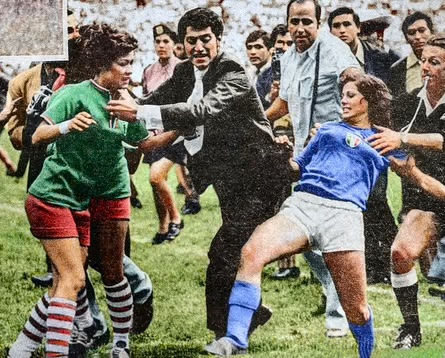
1971 was also the year of one of the most fascinating moments in women’s football history: the unofficial Women’s World Cup in Mexico, known as Copa 71. If you ahvent had the chance to watch the documentary COPA ‘71: The Lost Lionesses - produced by the Williams’ sisters - I highly recommend it (available on BBC iPlayer).
Six teams travelled to play in the tournament: England, Italy, Mexico, France, Argentina and Denmark, taking place across 2 weeks of the 1971 summer. The competition is named as unofficial, due to no recognised football association hosting it. Now whilst the 1971 competition is more well known in modern history, likely facilitated by the record number of fans turning up to games - 100,000 - the first known tournament to be named as a women's football World Cup actually happened in 1970 in Italy.
Denmark went on to win both the 1970 and 1971 competitions, showing their dominance from before history books even had begun to be written.
Building the Modern Game
From the 1970s onwards, the women’s game slowly rebuilt itself. The Women’s Football Association organised competitions and international matches, which still relied heavily on volunteers.
However, when the FA finally took responsibility for the women’s game in England in 1993, was when we began to see more structure and investment in the game, albeit at a slow pace.

Much of the 1990s and 2000s still saw a lack of full professionalisation, although historic clubs began to create women’s teams. Take Arsenal, they made their women’s team in 1987, but then you also have clubs like Manchester United who didn't create their women’s team until 2018. The real turning point didn't arrive until the 2010s when the English FA relaunched their top division of women’s football, best known as the Women’s Super League.
The launch of the Women’s Super League in 2011 created the first fully professional level of women’s football in England. With not just professional contracts, but professionalising other parts of the game too with sponsorship deals, media coverage, access and facilities.
The Explosion
If you ask any women’s football fan, or player in England when that shift in momentum kicked in, it would be answered by: when England won the UEFA Women’s Euro 2022. This moment was not just historic for women’s football, but also English football as a whole. This win was the talk of the country, and even brought in 87,000 fans at Wembley to watch the moment live.
This moment signalled public attention, better infrastructure, better coverage - an overall need to meet the demand that was; women’s football is here.

And since then we have seen growth in ways that once felt impossible. Whether that is through top flight football with record breaking contracts, or down to grassroots and PE classes where girls in England finally have more equity in access to football and sport.
This victory was built on decades of effort and fight from players, organisers and activists who refused to let the game disappear. Without them, there would be no sold-out stadiums today.
Women’s football didn’t suddenly become successful, but instead, it survived long enough to finally be taken seriously.


Comments