-3.png)
Exclusive Interview with Ashton Attzs: Football and the Power of Human Art

The rise of women’s football means that this is our space to create, whether that is through fan culture, digital media or artists, like Ashton Attzs.
At 27, the painter and illustrator has become known for bold, vibrant work celebrating LGBTQ+ identity and community. Yet her connection to football didn’t begin with major commissions or a carefully mapped career path. Like many creatives now contributing to the culture around the game, it started much closer to home.
Growing Up Between Art and Arsenal

Ashton, who was born in Luton and now based in Hertfordshire, has been drawing for most of her life. As a kid, that usually meant sketching the environments she was surrounded by; video game characters, family portraits, and plenty of drawings of her childhood dog.
“I’ve always been drawing since as long as I was able to hold a crayon,” she says.
That instinct to observe everyday life still runs through her work today. Ashton describes her style as “joyful and vibrant,” a celebration of ordinary people and everyday moments, expressed through painting and digital illustration.
But while art came naturally, football entered her life, as it does for many, through family tradition. Her dad is a lifelong Arsenal supporter, who grew up right by the stadium on Elfort Road, the street behind Arsenal Tube station, meaning football was never something distant from family life.
“Football was and still is always on in my parents’ house,” Ashton says. “My dad will never miss watching an Arsenal game.”
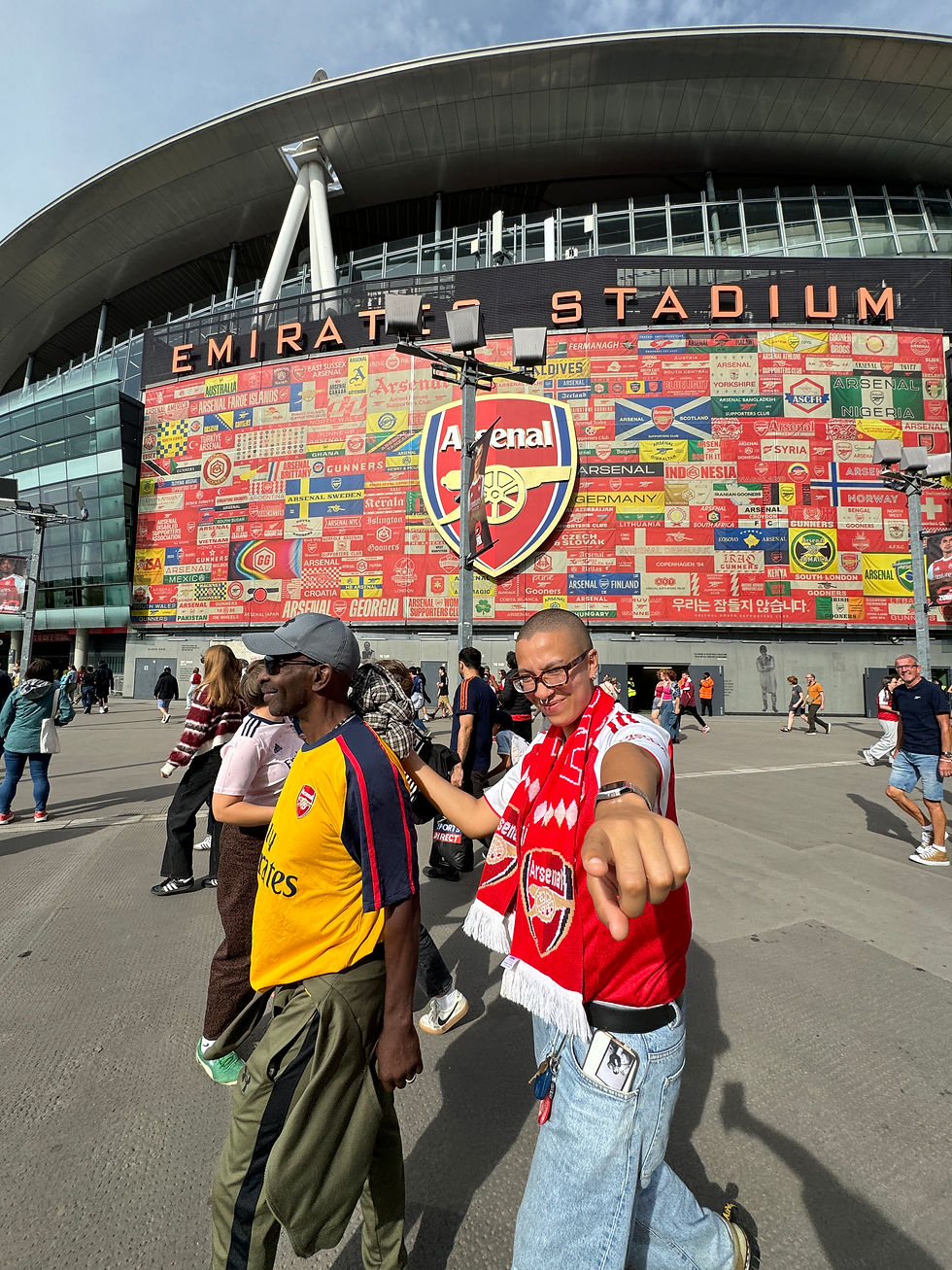
He tried to pass that love down early. She remembers receiving her first Arsenal shirt, the yellow and blue 2003/04 away kit, for her sixth birthday, along with the odd trip to a men’s game.It wasn’t until her twenties, though, that football really clicked, largely through Arsenal Women. These days Ashton regularly heads to the Emirates with her dad and her girlfriend, turning matchdays into a bit of a family ritual. Since her girlfriend finished chemotherapy last year, the three of them have made a point of going together whenever they can. A reminder that football fandom, like art, is often built around shared moments.
When Illustration Became a Career
For a lot of artists, the shift from hobby to career happens slowly. A slow transition from taking your passion from a side hustle, to opportunities you could’ve only dreamed of. For Ashton, that moment came earlier than she expected.
In her early twenties, while she was still figuring out life as a freelance illustrator, she landed a commission to design artwork for the Universal Music afterparty at the 2020 BRIT Awards.
“I think that’s when I realised illustration could be more than a hobby,” she says. “Working with Universal Music on such a prestigious project so early in my career really gave me the confidence to know there are so many possibilities working as an illustrator.”
After that, the work started to open up. Projects came in from different corners of culture and were often tied to the things she already loved in her personal life. She’s painted a mural for Bleecker Burger, collaborated with brands, and built a body of work that celebrates LGBTQ+ identity and everyday community.
And while football wasn’t part of the original plan, over time it found its way into the story too.
Manifesting a Football Commission

Sometimes opportunities arrive through careful planning, and sometimes they appear almost by accident. For Ashton, her collaboration with the Premier League’s “With Pride” campaign began with a small gesture for her dad.
Artistic by nature, whenever she gives someone tickets to an event, she likes to create a handmade illustrated version as a keepsake. So when she bought Arsenal Women vs Chelsea Women tickets for her dad’s birthday last November, she designed a custom ticket for the occasion. And much like the digital age we live in, Ashton posted a photo of him holding it on Instagram before heading to the game. At halftime, she remembers thinking, and then even saying out loud, how much she’d love to work on a football-related project.

Three days later, an email arrived from the Premier League asking if she’d like to collaborate on artwork for LGBTQ+ History Month, for their new campaign ‘With Pride’.
“It honestly felt like I manifested it,” she laughs.
For the campaign, Ashton created artwork celebrating LGBTQ+ supporters, including illustrations for the Gay Gooners community, blending club identity with Pride symbolism, but the project also carried deeper meaning.
Pride, Football, and Visibility
Pride campaigns in football, particularly in the men’s game, almost inevitably attract backlash.. Football clubs draw supporters from every background imaginable. There's no entry requirement to being a fan, and in many ways that openness is one of the sport's best qualities. Few spaces in modern life bring together such a broad cross-section of society. But that openness aklso means football reflects the worst parts of society too. Racism, sexism and homophobia haven’t disappeared from the game. If anything, football often mirrors those tensions more loudly than most places.
That’s why decisions around Pride initiatives still carry weight. Last year, when the Premier League stepped away from its long-standing partnership with the Rainbow Laces campaign, it seemed like a surprising decision to make in the current climate of the world. It felt like a step backwards, or at least a strange moment for a sport that still has a long way to go on LGBTQ+ inclusion. However, the league recently introduced its own internal Pride campaign, With Pride, and the reaction that surrounded it, tells us just why we need these campaigns. Men’s football, much like men in all aspects of society, still have an uneasy relationship with visible queerness.
That tension feels very different, almost non-existent, in the women’s game. That the game is, in fact, very much different, not only in access and infrastructure, but in culture too. Here, queerness isn’t treated as something unusual or controversial, it is the foundation of which the sport sits on top of. For many LGBTQ+ fans, women’s football offers something that can feel surprisingly rare. You can turn up, sit in the stands, and see a version of community that exists openly. Queer players, queer fans, queer stories, not hidden or apologised for, just part of the game. It offers a daylight, ‘safe’, queer space where you are surrounded by people like you, on and off the pitch.

The difference can be felt even in the same stadium. I can sit in the same seat at the Emirates watching Arsenal Women with my girlfriend and feel completely comfortable and then still, sitting in that same seat for a men’s game can feel very different. That contrast is exactly why campaigns like these still matter. The backlash they receive doesn’t undermine their purpose; if anything, it highlights just how necessary they remain.
For Ashton, that context made the project feel even more significant.
“I’ve been making art that celebrates LGBTQ+ identities since I started my career,” she says. “I’m a proud butch lesbian, so naturally my own experience shapes my artwork.”
Her approach was to balance visibility with something equally fundamental: fan culture.
“At the end of the day, LGBTQ+ football fans are still just football fans,” she explains. “What brings us together is the love of the game and devotion to the team.”
Rather than focusing solely on symbols, Ashton’s work aimed to capture the feeling of community inside football spaces. And while negative reactions to Pride campaigns still exist, she prefers to focus on the response that matters most.
“I’ve seen some really wonderful feedback from people on a personal level. What matters most to me is knowing LGBTQ+ football fans feel seen and celebrated.”
Why Women’s Football Feels Different
One reason Ashton finds women’s football such an inspiring creative space is the community around it. Compared to the often rigid culture of the men’s game, the women’s game has become a hub for artists, illustrators, designers, and creatives shaping the visual identity of the sport.
“There’s often a correlation between queer women being fans of women’s football,” she says. “And queer women are incredibly inventive when it comes to creating spaces where communities can thrive.”
The result of this, is a culture where creativity is welcomed rather than sidelined. From illustrated match posters to fan art, women’s football has become one of the few sporting spaces where grassroots creative expression sits comfortably alongside the professional game.
Artists like Lizzie Knott and Anna Trench - whose graphic novel Florrie explores the early history of women’s football and queer love - are part of that growing community, and Ashton sees it as something worth protecting.
The Value of Human Art
At the same time, creative work is entering uncertain territory. With AI tools now able to generate images in seconds, clubs and brands increasingly have the option to produce visuals instantly instead of working with illustrators.
Much of Ashton’s work is rooted in identity, emotion, and lived experience, all things that can’t easily be replicated by an algorithm or system.

“I want people to look at my work and know it was made by a real human being with thoughts and feelings,” she says.
At a time when technology is rapidly automating creative industries, that human element is becoming more important than ever. Illustration carries the imprint of the person behind it, whether that is culture, personality, or experience. In football, a sport which sits on the foundations of emotion and belonging, human connection is vital. Art created by the people who shape the game, will always carry and connect more than one generated by a computer.
Looking Ahead
For Ashton, football is just one part of a broader creative universe. She still dreams of collaborating with Arsenal, whether that’s designing a mural or creating a programme cover for an Arsenal Women’s match. Beyond football, her ultimate ambition is a project on the world’s biggest stage: “The Olympics would be my dream commission,” she says.
Whatever direction her career takes, the drive behind her work remains evident. As social climates shift and hostility toward marginalised communities rises in parts of the world, Ashton wants her art to remain, without a doubt, visible.
“I want to keep making work that honours diversity in all its forms,” she says. “I don’t want to dilute what I do creatively or who I am.”
Above all, Ashton hopes people see that behind every illustration is the artist who created it, because in a world increasingly shaped by AI, art that feels human might matter more than ever.


Comments