-3.png)
Exclusive Interview: ‘I thought I’d have to retire’: Claire Emslie on motherhood, returning to football and changing perceptions

Motherhood has often felt like something that comes at a cost. For women across all industries, there has long been an unspoken pressure that having children means stepping away from career ambitions, or at the very least putting them on hold. That feeling has been particularly prevalent in elite sport, where success depends almost entirely on the body, and where pregnancy was, for decades, viewed as the end of an athlete’s career rather than just another chapter of it.
Thankfully, this is a perception that is beginning to change. As football continues to professionalise and prioiritise women, clubs are investing far more in supporting players through pregnancy and motherhood, proving that football and family no longer have to be mutually exclusive. At the forefront of this shift are clubs that are going above and beyond to ensure that pregnancies in professional football are able to succeed, and at Angel City, the expectations of pregnant athletes are breaking through the roof. Scottish international, Claire Emslie, has become an example of what is possible when athletes are given the right environment to thrive.
Photo Credit: via @emslie_@2
Claire Emslie has enjoyed a career that has taken her across the world, winning trophies including the Scottish Women’s Premier League, the Australian W-League Premiership and the Women’s FA Cup before joining Angel City. In December 2025, the Scotland forward welcomed her son, Jamie, into the world. Just months later, she was back on the pitch, returning to club football before earning another Scotland call-up; a comeback that, not so long ago, many players would have thought impossible.
“I honestly thought I would have to retire if I wanted to have a baby” Emslie tells us.
Her story isn’t just about an impressive comeback, and exceeding the expectations of a pregnant athlete, it’s about how the women’s game is finally beginning to build the support systems that allow players to become mothers without sacrificing the sport they’ve dedicated their lives to.
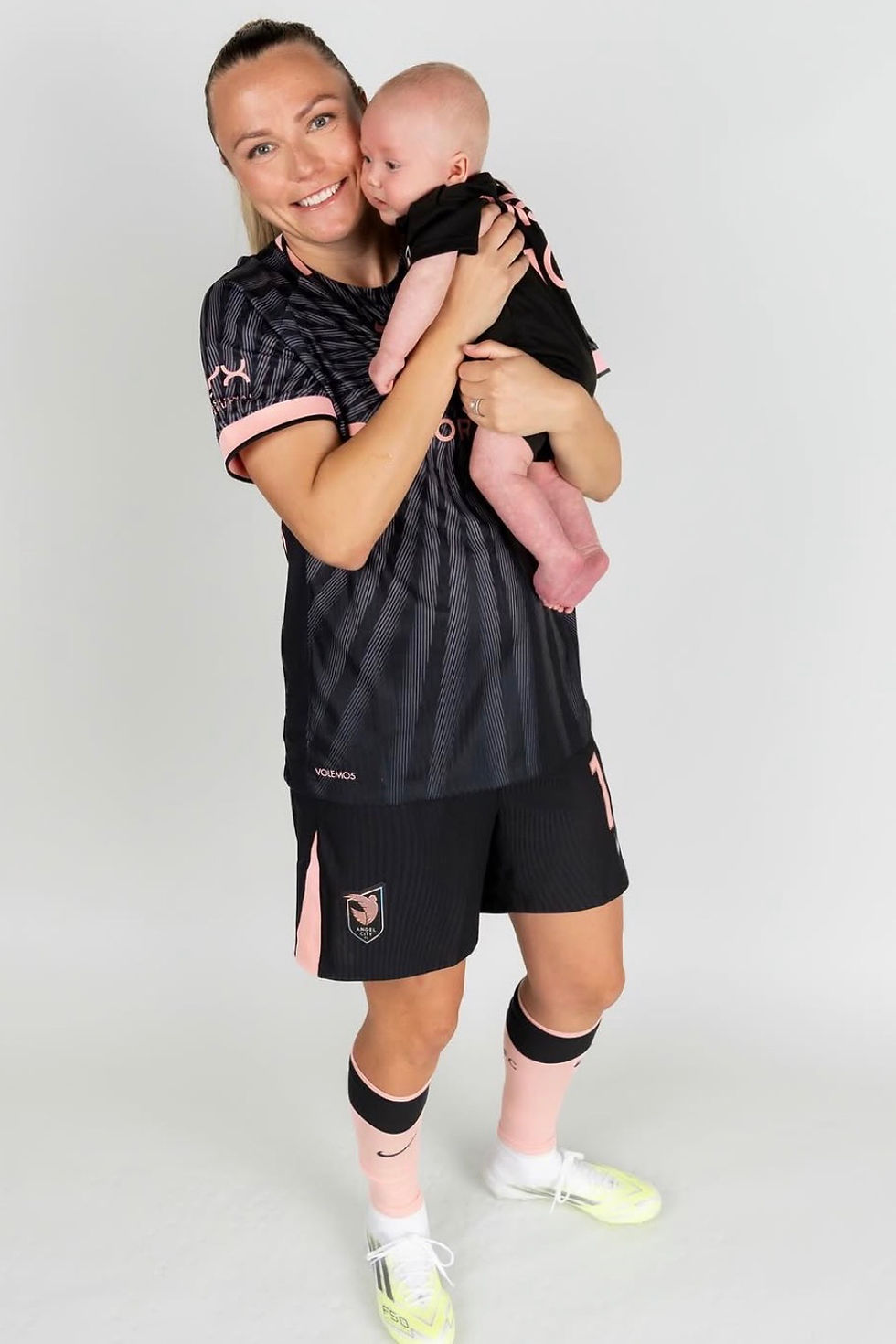
Photo Credit: via @emslie_22

Photo Credit: via @emslie_22
“When I was younger, it just wasn’t around,” Emslie explains. “We never saw it.”
Having spent much of her career in England and Scotland, pregnancy during a playing career simply wasn’t something she believed was possible.
“I think only recently I started to think, ‘You know what? I can come back,’ after seeing other athletes do it, especially in America.”
She credits Angel City with giving her the confidence to make that decision.
“If I wasn’t at this club, I wouldn’t have done it. I wouldn’t have come back. I probably would have waited until I retired.”
A Club That Planned For Pregnancy, Not Around It
Support is often spoken about in broad terms, but for Emslie it became evident from the moment she found out she was pregnant.
After telling her husband, the next person she called was Angel City’s Head of Performance.
“She put me at ease straight away,” Emslie says. “She told me it was safe to train up to 12 weeks, sorted doctors, explained everything and made it clear the club would support me however I wanted to approach it.”
When the time came to tell her coaches, she admits she was nervous.
“I didn’t know how they were going to react.”
Instead, she found a club that immediately began planning her return.
“They were just so happy for me. They said, ‘Whatever you need, we’re here to support you.’”
That support ranged from specialist medical care and pelvic floor rehabilitation to complete flexibility around training schedules, allowing Claire to decide each day what felt right for her body.
“Everything was planned almost like they were treating an injury or a period of time out.”
Pushing The Limits
One of the most impressive parts of Emslie’s pregnancy was just how active she remained, where she trained until the day her waters broke.
Strength and conditioning became a huge focus throughout her pregnancy, helping her avoid many of the physical issues people often expect.
“I had no back pain during pregnancy. I had no pelvic floor weakness. Studies show strength training really helps.”
Every week, the coaching staff monitored her sprint speed, partly out of curiosity and partly as a fun challenge.
“I kept saying, ‘Come on, just keep it above 80%.’”
Eventually it became something the staff gathered to watch.
“It honestly turned into a laugh,” she smiles. “One week I got it back up to 81%, and everyone was celebrating.”
For Emslie, it became proof of just how capable the body can be during pregnancy.
“It was amazing to see what my body could still do.”
Recovery Without Pressure
While elite athletes are often expected to bounce back quickly after injury, Emslie never felt that expectation following childbirth.
“There was no pressure from the club at all.”
Instead, every stage of her recovery following a planned C-section was based on how her body responded.
“We had targets each week, but if I wasn’t ready we’d just change the plan.”
As it happened, she exceeded almost every expectation.
“The medical staff were actually quite surprised,” she laughs. “Every marker they gave me, I hit.”
That experience has since become something she shares with other pregnant footballers.
“There’s a lot of fear of the unknown. But actually… it’s okay. It’s doable.”
More Than Just Football
Returning to training wasn’t only important physically, but it also became an opportunity to reconnect with a part of herself outside motherhood.
“Being a mum is hard,” Emslie says honestly. “So getting to play football, run around for a couple of hours, compete and just be one of the team again… it feels really special.”

She also acknowledges how isolating early motherhood can sometimes feel.
“When I first came back, maybe I’d only be in for an hour. Just getting out of ‘mum life’ for a little while and being around the team helped my mental health so much.”
And understandably, motherhood - like most big life events - really puts things in perspective.
“Football matters, but there’s more to life now. I just see it as a joy to play.”
A Scotland Return That Meant Even More
Just six months after giving birth, Emslie was back representing Scotland, and standing for the national anthem felt different this time.
“I’ve always thought about my family when I’m singing it. Now I had Jamie to think about as well.”

She admits she’d wondered whether motherhood might mean the end of her international career.
“I thought after having a baby I might not get back in.” Instead, being selected again felt almost like making her debut. “I felt so fortunate.”
With the 2027 World Cup now firmly in her sights, Emslie’s focus is simply on building minutes with Angel City before Scotland’s next qualifiers.
“That’s the dream. A World Cup in Brazil… it doesn’t get any better than that.”
Changing The Conversation
For Claire, the biggest thing she hopes her journey changes isn’t perceptions of herself, but perceptions of pregnancy in elite sport altogether. “When I was pregnant, I searched for so much information,” she says. “Any positive experience you read, you really hold onto it.”
She’s keen to challenge many of the assumptions surrounding pregnancy, from losing fitness to never sleeping again.
“I didn’t have sickness. I didn’t have cravings. I genuinely felt normal throughout my pregnancy.”
Even after Jamie arrived, she and her husband quickly found routines that allowed her to recover while continuing to breastfeed.
“Everyone says you’ll never sleep again,” she laughs. “But if you work out a schedule, you can still get that recovery.”
More than anything, the experience has reinforced one lesson she’ll carry through the rest of her career.
“I think it’s just how powerful your mindset is. Whether you think you can or you can’t, that’s what you’ll do.”
For generations of female footballers, motherhood often marked the end of a career. Players simply didn’t have the support, infrastructure or examples to believe otherwise.
Emslie is part of a growing group changing that narrative. Her return isn’t remarkable because she came back after having a baby, but instead, it’s remarkable because, with the right club, the right support and the right belief, she’s showing that one no longer has to come at the expense of the other.


Comments