-3.png)
Esther González and the Cost of Queer Visibility in Women's Football
- Amelie Kirk
- 4 hours ago
- 4 min read

Queerness has always been foundational to women's football, in fact, it was what invited me in. It served as the open door for many of us who never found a home in the hyper-scrutinised and heteronormative spaces of the men’s leagues. It offered a rare daytime space to see queer women thrive openly, far away from a community scene where nightlife and bars are usually the only options. And it isn’t just in the stands that I see people like myself, it’s those on the pitch too. Those are the women who would have saved me years of shame and confusion if I’d seen them on my telly as a little girl and who now serve as that vital mirror for the next generation.
LGBTQ+ people are taught how to hide almost before we are taught how to live, whether it’s shielding ourselves through a confusing childhood, a hostile workplace or unaccepting city. That early-stage survival instinct is a painful, heavy part of our shared history. Which makes it so poignant to watch this situation unfold with Esther González.

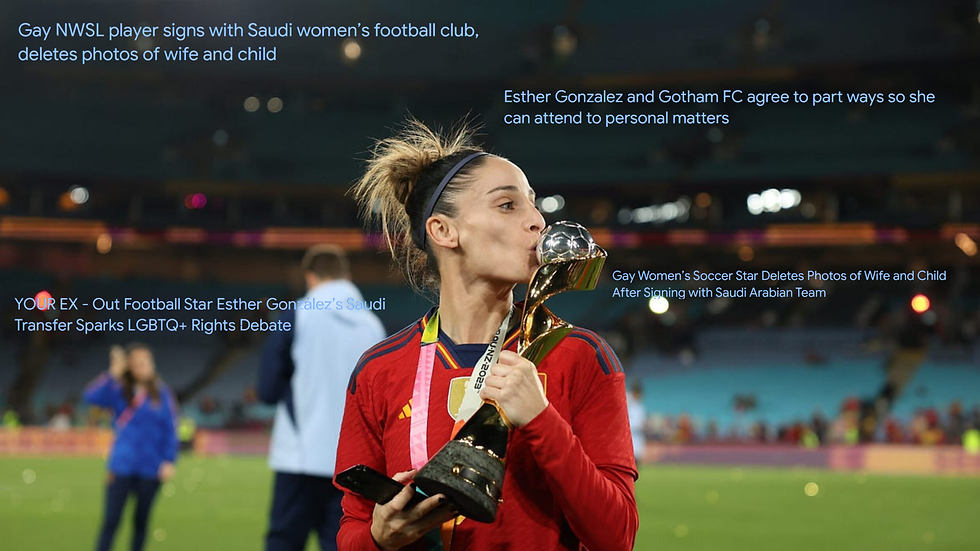
The 33-year-old Spanish striker abruptly parted ways with Gotham FC in July, citing that she would be temporarily stepping away from football to “to attend to personal matters in Spain”. Within weeks, however, it was announced she had signed with Saudi Arabian club Al Qadsiah. Alongside the transfer, digital traces of her family life vanished, her social media accounts were scrubbed of photos featuring her wife and nine-month-old son. Watching someone who had built such a loud, proud life – a woman in the public eye with a wife and a child – quietly fold up that hard-won visibility to move to a country where homosexuality is not only illegal but punishable with the death penalty, feels unsettling.
However, at 33, González is nearing the natural ending of a professional career where most female players hang up their boots in their early thirties. That reality was likely compounded on the pitch with her exit from Gotham coinciding with the club bringing in the high-profile striker Sam Kerr, raising the very real prospect of her minutes getting squeezed. Facing the end of her playing days, it is hard to entirely absolve a veteran player for making that trade, yet it’s equally impossible to ignore the claustrophobia of approaching the end of a career where loyalty doesn't pay the bills.

Although the exact financial terms of González’s contract with Al Qadsiah remain confidential, it is safe to assume she is securing a substantial upgrade, given that she arrives as the first World Cup winner to make the move to the Saudi side and will undoubtedly anchor their attack as their star striker. It forces us to confront an uncomfortable truth, we want our heroes to be bulletproof, to turn down the millions and stay beacons of uncompromising pride. But endurance has a cost and when a system underpays you for your entire prime, walking away from generational security is a luxury. Nobody wants to admit how quickly moral clarity blurs when faced with the chance to buy a house, secure a child's future or avoid the financial cliff of post-retirement life in a sport that has never valued its women equitably.
When one or two seasons of hiding an identity that took a lifetime to build can trade for financial freedom, you realise this may says less about González herself and more about the harsh financial realities of women's football. When there is a staggering price tag attached to your identity, we have to ask: if players were paid fairly in progressive leagues like the NWSL, the WSL and Liga F, would any woman ever have to trade her safety and visibility to secure the financial future of her family?

At the end of the day, we don’t know the exact personal pressures or private calculus that drove Esther González to Spain before her move to Saudi Arabia, nor do we know the exact figures attached to the contract that made such a departure impossible to refuse. But as a fan who found a lifeline in the open, unmasked queerness of the women's game, it does hurt to watch a sportsperson erase the very visibility that made her so worthy of admiration in the first place.
However there is a glaring double standard of how we police these moments. When an individual player takes the money, she bears the brunt of our collective heartbreak and moral interrogation. Yet, the corporate leagues, global governing bodies and wealthy western institutions that happily court Saudi investments, partner with state-backed sponsors and turn a blind eye to human rights abuses in the name of expansion rarely face the same righteous fury. If we are going to hold queer athletes accountable for compromising their values in the face of life-changing capital, we must apply that exact same level of scrutiny to the powerful entities building the systems that force those impossible choices to begin with.


Comments