-3.png)
Australia and Japan Call Out Women’s Asian Cup Prize Money Gap
- Amelie Kirk
- Apr 8
- 3 min read


The Women’s Asian Cup has grown into a tournament that genuinely feels like it matters, not just within Asia but across the wider football world, where the level of play, the intensity of matches and the visibility of the teams involved have all lifted in ways that are hard to ignore. For established powerhouses like Australia and Japan, it has become a stage that reflects how far the women’s game has come, with both sides helping to drive standards higher while drawing in larger audiences and more serious attention with each edition.

That is what makes the financial reality behind it feel so out of sync. Following the 2026 tournament, players from Australia and Japan released a joint letter criticising the prize money structure, stating that it fails to reflect the current state of the game. “The current prize money does not reflect the level of investment, performance and growth of the women’s game” they said, pointing to a gap between what the competition delivers on the pitch and how it is valued off it. The numbers themselves are difficult to overlook, particularly when placed side by side. The total prize pool for the Women’s Asian Cup sits at around $1.8 million, while the men’s equivalent reaches roughly $14.8 million, a difference that becomes even more striking when considering that only the top four teams in the women’s competition receive any prize money at all. For several nations, participation at the highest level in the region still comes without any financial reward, despite the costs and commitments required to get there. Additionally, both Australia and Japan respectively sit among some of the most influential teams in women’s football globally, with a level of success and visibility that has, in many ways, outpaced the impact of their men’s sides, yet that reality is still not reflected financially.

In the letter, the players made clear that going public was not their first move, explaining that they had already tried to engage directly with the Asian Football Confederation. “We made a proposal to the AFC to work together on this,” they said, outlining an attempt to collaborate on solutions that included equal prize money, guaranteed distributions for players and a broader plan to strengthen the tournament’s long-term future. That proposal, they noted, was not taken forward. What gives the statement additional weight is the fact that it comes from two of the most influential teams in the region, both of which have consistently performed at the highest level and helped shape the direction of the sport. When players from Australia and Japan speak in unison, it suggests that the issue is not confined to one federation or one experience, but reflects a wider structural problem that sits at the heart of the competition.

There is also a practical dimension to what they are raising, because prize money does more than reward success at the end of a tournament. It influences how federations prioritise their women’s programmes, how players are supported throughout their careers and how realistic it is for emerging talent to see football as a viable professional path. When financial backing lags behind the growth of the sport, progress risks becoming uneven and, in some cases, unsustainable. The players argue that addressing this gap would have a broader impact than the figures alone might suggest, describing equal prize money as “transformational” for the women’s game in Asia, particularly for nations still building their presence on the international stage. It is a point that challenges the idea that disparities can simply be explained by revenue, instead suggesting that investment is part of what drives the growth that governing bodies often say they are waiting for.
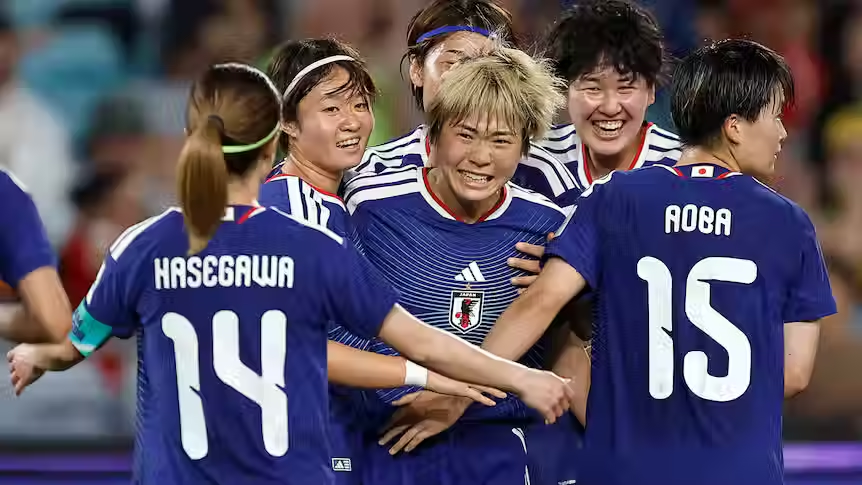
The Women’s Asian Cup, in its current form, already demonstrates what the sport is capable of delivering, with competitive matches, recognisable stars and a growing audience that continues to engage with it more seriously each cycle. The question raised by Australia and Japan is not whether the tournament has value, but why that value is still not being reflected in the structures that support it. For a competition that has done so much to prove itself, the issue now is whether those in charge are willing to catch up with what is already happening on the pitch.


Comments