-3.png)
2016 WOSO Rewind

With the new year well under way, a lot of us have found ourselves reminiscing, and somehow, 2016 keeps coming up. For many, it still feels like yesterday. In reality, it was a decade ago, and when it comes to women’s football, the game was in a very different place.
So let’s rewind and take a look at what the women’s football landscape looked like in 2016 - the leagues, the crowds, the competitions, and the players who were laying the foundations for everything we’re seeing now.
The WSL in 2016

The 2016 WSL season ran from March to September, just before the league made the switch to a traditional football calendar the following year. With only nine teams in the division, every matchweek saw one side sit out, a huge contrast to today’s 12-team league, with expansion to 14 teams already confirmed for next season.
Chelsea entered the campaign as defending champions, but it was Manchester City who lifted the title, their first, and still only, WSL crown to date. Eni Aluko finished the season as Golden Boot winner for Chelsea, while City and Chelsea occupied the only two UWCL qualification places available at the time.
At the other end of the table, Doncaster Rovers Belles were relegated after finishing the season with just three points. And in a reminder of how fragile the women’s game still was in 2016, Notts County finished sixth, only to fold completely after the season ended.

In WSL2, 2016 marked the first season with promotion into the top flight, with Sheffield United going up. It was also a period where several clubs now firmly established at the top were still working their way through the pyramid, with Aston Villa and Everton both competing in WSL2 that season.
Yeovil Town and Bristol City secured promotion to WSL1, but their journeys since have diverged sharply. Bristol City now compete in WSL2, while Yeovil play in the National League after losing their licence following administration.
Attendance: A snapshot of growth
Attendance figures from 2016 offer one of the clearest illustrations of how far the game has come.
That season, the highest recorded WSL attendance was 4096, with an average of 1128 fans per match. Fast forward to the current season, and we’ve already seen 56,537 fans pack out Arsenal v Chelsea. Even the lowest attendance recorded so far this season, 1404, is higher than the average crowd in 2016.
2016 World Stage

In Germany, Bayern Munich won the Frauen-Bundesliga by ten points, back when Vivianne Miedema was playing for the side. In France, Lyon claimed their 10th consecutive Division 1 Féminine title, powered by Ada Hegerberg’s impressive 33 league goals!
In Spain, Liga F, then known as the Primera División, was won by Athletic Bilbao, edging the title by a single point. Barcelona finished second, beginning a four-year stretch without a league title, though their attacking DNA was already clear, with Jenni Hermoso finishing as top scorer.
Meanwhile, in the NWSL, Western New York Flash lifted the trophy. The club has since dissolved, but their squad featured names that remain as key players in the game today, including Sam Mewis, Lynn Williams, Alanna Kennedy, Adriana Leon and Sabrina D’Angelo.
Domestic Cups

In 2016, both domestic cups carried real weight, as they do now. The League Cup, then sponsored by Continental Tyres, featured 19 teams from WSL1 and WSL2. Arsenal were the defending champions, but it was Manchester City who lifted the trophy after a 1-0 extra-time win over Birmingham City, sealed by a goal from Lucy Bronze. Yet again, reminding us from the early days that her big-game mentality has been there from the start.
The FA Cup saw Arsenal assert their dominance once again, beating Chelsea 1-0 at Wembley thanks to a goal from Danielle Carter, who has recently announced her retirement from professional football. The final drew a crowd of 32,912, an impressive figure at the time, but compared to the 2025 FA Cup final, which welcomed over 70,000 fans, shows impressive growth.
UWCL 2016
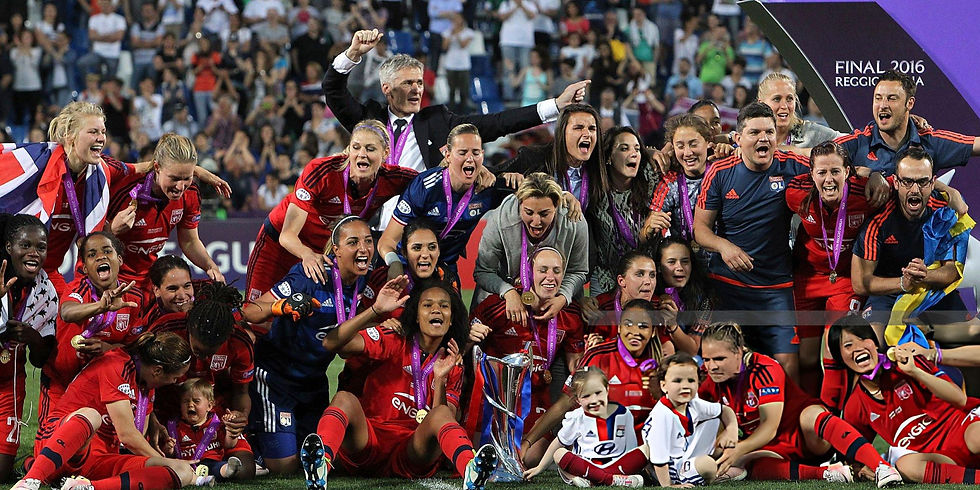
The 2015-16 UEFA Women’s Champions League final was held in Italy, where Lyon defeated Wolfsburg on penalties following a 1-1 draw.
Hegerberg finished the tournament as top scorer, proving how key she is to that Lyon side.
Attendance for the final stood at 15,117 in a stadium with a capacity of just over 21,000, a strong showing at the time, and another marker of how far the competition has grown.
The Squads: Some Major Throwbacks…
Looking back at some of the 2016 squads feels like a major shock when you see some of the players at certain clubs!
At Arsenal, academy players including Leah Williamson, Lotte Wubben-Moy, Chloe Kelly and Taylor Hinds were already part of the setup, alongside names like Asisat Oshoala and Vicky Losada.

Chelsea’s squad listed Alessia Russo (one that Arsenal fans might want to forget) and Miri Taylor as academy players, while Niamh Fahey and Hannah Blundell were part of a young group still finding its feet.
Manchester City’s side featured what now reads like a future all-star lineup: Lucy Bronze, Keira Walsh, Ella Toone, Georgia Stanway, Nikita Parris and Ellie Roebuck, with Kosovare Asllani now captaining London City Lionesses. Ella Toone in blue might feel like a fever dream, but at the time, there was no women’s team for Manchester United, giving Toone no other choice but to flourish elsewhere.
Mary Earps was in goal for Reading, long before rewriting history. And Beth Mead, whilst it is now hard to imagine her not in red in North London, was developing at Sunderland. Jess Carter and Ann-Katrin Berger were playing together at Birmingham City, and have since gone on to play together at Chelsea and, now, Gotham FC.

And at Liverpool, a stacked squad included Katie Zelem, Alex Greenwood, Caroline Weir and Niamh Charles, players now firmly associated with the very top of the game.
2016 Wrapped
Looking back, 2016 feels like a snapshot in time of a mid-growth game. WOSO on a smaller scale, but so much talent was already bubbling away under the surface.
It’s a reminder of how far the game has come, and how quickly things can change when investment, visibility and belief start to line up.
Now over to you. What was your standout footballing moment of 2016? A goal you still think about? A team that made you fall in love with the game? Or maybe it’s just the nostalgia hitting.


Comments